Christmas on the Magothy: We Have a Winner!

Back in August, Gillymole Press announced its return to mainstream publishing with the Christmas on the Magothy Serial Fiction Contest, which we here at the NBTC were so excited about until some idiot who was still bent out of shape about a series Gillymole ran…what?…four years ago or something (get over it people, at some point we have to stop burning businesses down just because we don’t like their font choices) spoiled things for a lot of people by torching the publisher yet again and driving them back underground for the sixth time in so many years.

Well, thanks to the generosity of Emmer and Colickroot’s new Icker-O’s, the breakfast cereal made (and made famous!) right here in town by the tremendous “wellness results” it delivered to a test group (in conjunction with a strict program of Fletcherizing) at St. Whit Gammerbund’s Rest Home for the Mentally Chaotic, the contest was reinstated in September and today we have the honor of announcing a winner. It’s our very own Miranda Fennel, Star Intern and ace Coffee Getter!

With Fennel’s budding fiction career right within reach, we figured we’d better get an interview in quick, along with another round of cappuccinos. So here now, is the NBTC’s exclusive interview with the winner of the Gillymole Press Inaugural Christmas on the Magothy Serial Fiction Contest, sponsored by Icker-O’s!

(Full disclosure: the transcript below is not what I showed Hallie, but it is what actually happened, no matter what shows up here tomorrow–KM)

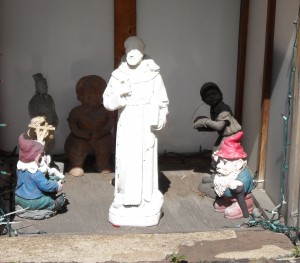
Representation of Fennel with the NBTC staff. From left: Wilmer Cobblebridge (sitting dwarf); Fennel (Chinese warrior); Kate Milford (chubby rusted figure at rear); Charlotte Gracechurch-Ferry (baseball player); Howard Weblend (standing dwarf). Oh, and me, Hallie!

Representation of Fennel with the NBTC staff. From left: Wilmer Cobblebridge (sitting dwarf); Fennel (Chinese warrior); Kate Milford (chubby rusted figure at rear); Charlotte Gracechurch-Ferry (baseball player); Howard Weblend (standing dwarf). Oh, and me, Hallie!

Halliday Moxton, NBTC Webmistress: So! Miranda Fennel! A new job at Nagspeake’s premiere tourism website, and an award-winning serial novel all in one week! Tell us what it’s like to live the dream. Did you happen to get any raw sugar, by the way?

Miranda Fennel: What, specifically, are you referring to as “the dream?”

HM: Sugar?

MF: Hallie, seriously? There’s about a million sugar packets in the kitchen. I just got back from Starbucks.

HM: Raw sugar, Fennel.

MF: This isn’t happening until I go get sugar, is it?

HM: Well, Fennel, I want to give you the best possible interview I’m capable of, and I just don’t know if I can do that with an overly-bitter latte.

(Long pause as Miranda gathers up her coat and stomps out.)

HM: Kate, sweetie, you’d better go with Fennel and finish the interview. And bring me a scone, because Fennel’s going to need to bring fresh lattes. These are going to get cold before she gets back.

(For the record, I am supposed to be off of coffee detail now. Supposedly that’s why we hired an intern. Not that I care, because coffee detail at least gets you out of Hallie range for whatever time you can make it last. Anyway, Miranda and I went and got a scone and raw sugar and lattes and a pint of scotch and spiked Hallie’s coffee with it.)

Actual picture of Miranda Fennel that Hallie could have used in the first place.

Actual picture of Miranda Fennel that Hallie could have used in the first place.

KM: So describe your winning piece to me briefly, so that we may conclude this interview in the two blocks between here and the office.

MF: Basically I figured it couldn’t fail if I stuck vampires into a Christmas story. And I stuck some elves in there, too, for good measure. And some references to Fletcherizing and dry cereals, because, you know.

KM: Icker-O’s.

MF: Yep.

KM: Good plan. Can’t wait to read it.

MF: Oh, I can’t wait for Hallie Moxton to read it.

(Awkward moment of Miranda looking downright crafty while I try not to look like I’ve noticed. This may bear watching, but in the meantime, look for DEATH IN A PEAR TREE, the first installment of Miranda Fennel’s winning serial, UP ON THE HOUSETOP, VAMPIRE CLAWS–coming this week here on the NBTC site and in select packages of Icker-O’s now through Christmas.

I know I’ll be reading very, very carefully.  KM)

Tags: , , , , , , , , ,

The Funicular Railway

The Ledge: Why the Funicular Railway Ends in the Middle of Nowhere

The passengers to make the inaugural climb on the Funicular Railway included four of the city’s top ranking officials, a cub reporter who had no business being there, and a man nobody in Nagspeake is sure ever existed. The uncertain man read a poem, and in so doing, saved the life of the cub reporter, who hadn’t known until she heard the poem that her invitation to record that first climb had been an invitation to her own murder. Or so Charlotte Gracechurch-Ferry told me one night after one too many cocktails. I had to twist her arm to get her to keep talking once she’d sobered up, but it was worth it. This is a tale of murder, monopolistic mail-order shenanigans, a rattletrap railroad, and the Shutter Club.

Wait, you say. What could murder, mail-order shenanigans, and the Shutter Club have to do with the Funicular…or, goodness, each other?

I will tell you.

It’s a familiar landmark to anyone who’s bothered to leave his or her vacation house in Bayside for a deeper look at the city: the Slope’s pride and joy, the old Funicular Railway that rises from Spanner Street to the Hilltop Overlook Station, from which a “picturesque offroad hike” through unpaved wilderness will take you to St. Whit’s Asylum, Ferrous Sanctus Monastery, the Magothy and Whilforber Railroad, or (via descent by bouncing Hill Bus), the Quayside Harbors. In theory, you can also get to the Shutter Club Mansion from the Overlook, but in reality if you were going to be let through the gates, you wouldn’t be taking the Funicular to get there.

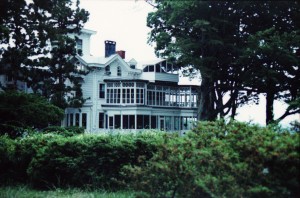
Shutter Club, circa...?

This is the only photo we have on file of the Shutter Club Mansion, and I’m required by law to state that the owner of record of the Mansion states that this isn’t the house we claim it is. You can make up your mind on your own, though; take the Funicular yourself and look to your left as you stand on the old stone patio of the Overlook and face up the hill. The big white structure peering out of the trees looking a whole lot like the picture above is probably the Shutter Club Mansion. If you aren’t convinced, walk along the only road that appears to head toward the white building.

On the way, just before you get there, you’ll pass the abandoned but beautiful patio with a grandstand and an overgrown croquet field that was supposed to be where the Funicular ended. Pause here and have a look around. Imagine how this platform looked when it was first built. Meditate on the fact that it was never used. Then move on. Keep on walking another half mile until you come to a giant wrought-iron gate with a large bronze plaque mounted in the center that reads

SHUTTER CLUB
ENTRY RESTRICTED TO MEMBERS
PLEASE NO PHOTOGRAPHS

which always makes me laugh, as the Shutter Club is, or was, or is supposed to be, a photography club.

Discussion of the Shutter Club is important to a discussion of the Funicular for two reasons. Firstly, the Funicular Railway gets you the best view of the Mansion it’s possible to get without calling a score of armed guards down on you, and the Shutter Club’s guards are no joke. They wear bowlers and tweed hunting suits with patched elbows and tall India-rubber boots, and they carry shotguns open, over the crooks of their arms. At least, they look like shotguns, to the same extent that the guards look like leisurely wildfowl hunters; which is to say: only until one of them aims or looks directly at you. Then the facade comes crumbling down and you realize how very wrong you were to trespass.

For many years the guards were presented as the hunters they looked like, and a couple generations of Nagspeakers trying to creep up for a look through the mullioned windows of the Mansion just thought a private hunting preserve ran up against the Shutter Club grounds when they were run off by the gun-toting men in tweed suits. Even the anachronistic dress could be explained away as a quirk of the “hunting club” that appeared to be entrenched up on the Hilltop. A few speculative and some outright fanciful articles were written about it, and in one surviving travelogue from sometime in the last century I even found a reference to the Gentleman Shooters’ Most Dangerous Game Preserve, along with a single photograph, a contact name, and a phone exchange. The supposed name of the preserve makes me think the Shutter Club itself got into the fun for a while (the contact, by the way, was a “Mr. Dick Connell, esq;” when I dialed the number, I was answered by a recording I think might’ve been audio from the “Small Game for Big Hunters” episode of the Avengers, which was perfect because the man in the photo was clearly Patrick Macnee. Needless to say, nobody returned my call). The first inkling people seemed to have that the Gentleman Shooters weren’t what they appeared to be should’ve come much earlier, though, when a scattering of tweedy fellows in India-rubber hunting boots began to look like permanent fixtures during the construction of the Funicular Railway, which brings us to the second reason the Shutter Club overlooms the Funicular in more than just the geographical sense.

The Slope and Hilltop Inclined Railway, to call it by its proper name, was built sometime approximately a hundred and fifty years back (as nearly as I can figure, records being blah blah blah. Actually, Wilmer Cobblebridge of the NBTC claims his father worked on the building of it, which either means my reckoning’s off by a good half-century or Willie’s a lot older than he claims to be). It was built to commemorate an anniversary (God knows which one) of the opening of the Nagspeake terminus of the Magothy and Whilforber Railway line up at the crest of the Hilltop. So it seemed to be all in good fun that, on the night before it was opened with great fanfare to the public, persons unknown found some way to move the entire vertical length of the Funicular to an entirely different location on the Slope.

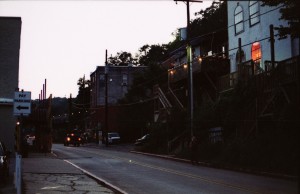
West Spanner Street

I know how absurd this sounds, but remember that it had been done before with the Terminus on the Hilltop (see my post here: http://theexpat.nagspeake.com/2009/05/we-call-it-research-mr-flyre/). When it happened again with the Funicular, people freaked out, of course, but with a kind of delight: the whole thing looked like the coolest tribute ever. With no hesitation, as if he’d been in on the joke the whole time, the Mayor of Nagspeake lead his constituency through the angled streets of the Slope from the original location on West Spanner Street (above) to the new location of the inclined railway two miles down the same road. He threw the switches that set it into motion, and then the Mayor and a select group of officials climbed into the bullet-shaped green car for its inaugural climb. The honored party included Julius Honorius Deacon, the visible half of the eponymous mail-order catalogue empire Deacon and Morvengarde; Holden Ulenborrow, son of Slope real estate magnate Joshua Hortus Ulenborrow; and Cattrick Sullen, the patriarch of the Magothy and Whilforber Railroad. There was also one member of the press, cub reporter Hannelore Ferry; and one poet: Owen Ilford, who may actually have opened the ceremonies that morning by reading a piece called “Pruning the Iron Skyward.”

A very brief digression: there is no historical record (obviously, considering the state of historical record in this city) of Owen Ilford actually having been in the car, other than Charlotte Gracechurch-Ferry’s recollection that her great-gran Hanna told her “That poet guy shoved into the car at the last minute, and the rest of the stuffed shirts knew they’d look like dicks if they told him to get off in front of everyone.” But Owen Ilford, or someone who called himself by that name, did write the homily that came to be associated with the disastrous events of the opening of the Funicular, and a number of Ilford scholars, including Dr. Edsel Price, believe Ilford may even have read his poem in the role of poet laureate of the city. But this is a debate for another time and for other people. Bad things happen to Ilford scholars, and I like my life the way it is.

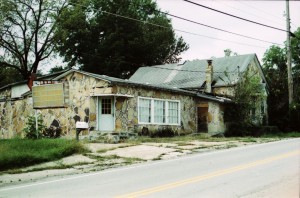
But back to the grand opening. The green car made its way up to the crumbling patio at the top of the Funicular’s new trajectory, a platform that had at been built as a scenic overlook long, long before and was in a state of miserable disrepair. The original location—the one you passed while walking to the Shutter Club several paragraphs ago—had a grandstand, a picnic area, and a gorgeous little gazebo snack shop built specially to be a destination for railway riders, and those things are still there, shuttered and abandoned because there’s no good way to get to them. The new landing has a restaurant that had been closed for as long as anybody could remember even when the Funicular lurched to life so long ago. Since then it’s passed through a number of hands who’ve tried to make it successful, but at the time of this writing its most recent incarnation is long dead, just like all the others.

stonehousewithrandommarquee

So the million-dollar question is, who moved the Funicular Railway and why? Certainly the city of Nagspeake lost out on the deal. Who came out ahead?

Well, here are some facts. The move put the Funicular two miles further from the Shutter Club Mansion, and put a rocky outcropping of Whilforber Hill between them, obscuring the huge picture windows of the Mansion’s ballroom from railway riders. Two nights before the night of the move, the Shutter Club held one of its infamous Sepia Balls. The next day, someone rang the doorbell of a starry-eyed reporter sharpening pencils at Mache, a second or third-tier broadsheet renting offices at the outskirts of the Printer’s Quarter. The reporter went to her editor with something big enough to make that editor drink way too much at a party that night in the Quarter. There, the editor made the mistake of telling at least fifteen people in attendance that he had something that was going to take the Shutter Club down a few pegs. The next day, the editor didn’t show up to work. That following night, the Funicular Railway was miraculously picked up and moved out of range of prying eyes.

Early, early the morning of the opening, the Mayor’s secretary knocked on the door of the starry-eyed reporter and invited her to join his honor for the first climb. And at the last minute, some poet shoved his way into the car before it started up the Slope. Six people went up; six people came down. The band played, the crowds went home. The editor never turned up again. It was presumed he died an accidental death after drinking too much.

Hannelore Ferry told her great-granddaughter Charlotte, my boss, that Owen Ilford probably saved her life by tagging along that day. In the car, according to great-gran Hanna, Ilford took a piece of paper from his pocket, asked the four rich and powerful men to sit, and read a second poem, one that’s never turned up in any Ilford publication I’ve been able to find. For those who don’t know, Owen Ilford wrote a few historical poems and a lot of poems about murders. This second piece was one of the latter, and it took all of two lines for Hannelore to realize Ilford’s poem was about the events the stranger had told her had taken place at the Sepia Ball two nights before. Three stanzas later the piece became a poem about the disappearance of a broadsheet editor, and then about the death of a starry-eyed cub reporter in a railway car. Horrified, she watched the other four men in the car squirm. How they were involved she had no way of knowing just then, but it was clear to her that she hadn’t been brought up the railway to document the historic occasion at all. She’d been brought up to have an accident, because of what she knew about what had gone on at the Sepia Ball.

The poet finished his reading, re-folded the paper, and calmly told the rest of them that he was considering including the piece in his next anthology, but that his editors thought it sounded too fantastic to be believed. He asked them what they thought. One by one the four rich men agreed that the events of the poem seemed a little far-fetched. They looked at Hannelore Ferry, who took a deep breath and agreed. Owen Ilford nodded and said he thought he’d probably leave it out if they all thought it was too much. They got out at the landing with its abandoned restaurant and crumbling patio all but tumbling down the cliff. They looked around, set off a few fireworks for the crowds down below, filed back into the car and began their descent. The dozen tweed-suited guards that had materialized out of the woods surrounding the landing melted back among the trees, shotguns open over their arms, rubber boots making no noise as they disappeared, and the six in the car pretended they hadn’t seen them. Or so Hannelore Ferry told Charlotte Gracechurch-Ferry before she died.

So what happened at the Sepia Ball to cause all this ruckus? Well, it happens every year, and it’s become a thing of legend—mostly grim legend, woven from unconfirmed rumor, uncomfortable dreams, and the occasional cautionary bedtime story. The most infamous tales concern a Ball in the 20’s given to honor the stars of a serial film that was shot, in part, at the Shutter Club—but that’s just one year, one vintage of really bad stuff going down in the white mansion on the hill. Whole anthologies of suspense and sometimes outright horror tales are released after the Ball every year, mostly by anonymous contributors and imprints that don’t publish their addresses. Bad things happen to Ilford scholars, but Sepia Ball speculators usually get it even worse. And that’s when their bodies turn up; most just disappear, like Hannelore Ferry’s editor. The only thing that saved the reporter herself, it seems, was the intervention of the city’s most famous phantom: the poet, Owen Ilford.

In the end, Hannelore refused to say right up to the end what she knew, and anyhow there’s no way to prove any of what she told Charlotte. Just one more bit of grim legend surrounding the Shutter Club; just one more lost tale of murder by a poet nobody’s sure ever existed. The Funicular carries on, its two green cars passing each other midway up the Slope with the Mansion looking on from its perch on high, keeping its secrets.

The Slope and Hilltop Inclined Railway

East Spanner Street, at Salvation Court; and Hilltop Overlook Station
Departures on the hour and half hour from East Spanner Street;
on the quarter and quarter-to from Hilltop Overlook Station.
Fares are free for children under 12 and fifty cents for adults.

Kate Milford is a regular contributor to Nagspeake.com, and also very good at miscellaneous filing and collating assignments. Her first book, THE BONESHAKER, comes out this spring from Clarion Books.

Coming soon: using administrative skills learned here at the NBTC offices, Kate descends into a veritable hell of back issues of the Gillymolle Press Journal in search of unpublished Owen Ilfordiana. We wish her the best, but have already picked out the wreath we’ll send to her funeral.

Tags: , , , , , , ,

Local Music

Like any moderately-sized city, Nagspeake has a large and thriving music scene! For traditionalists, there’s the Magothy Symphonette and the Mid-Coastal Orchestra. For jazz lovers, there’s the annual Jazz, Blues, and Pig Out at Cape St. Charlestown Park. Then there are the many saloons, restaurants, and clubs that feature live music. These, on the other hand, should be approached with caution. Nagspeake takes its music almost as seriously as it takes its history, as evidenced by the Ilford/Mapp riots of the last decade. (Have a look at Edsel Price’s celebrated writings for more on this fascinating subject.)

One of the most exciting musical presences in Nagspeake is, of course, the Asylum Choir of St. Whit Gammerbund’s Rest Home for the Mentally Chaotic. Modeled on the therapeutic theories of the French Abbé François Simonet de Coulmier (a pioneer in the practice of therapy through art), the Asylum Choir was created by the third director of the Rest Home, Doctor Aliabadi Smith. Dr. Smith’s experiment yielded great results; if it has not resulted in the revolution in psychiatry the good doctor hoped for, it has given us over a century of distinctive music–woe to all who missed last year’s performance of Cadrixian’s opera Winterfowl!

Less therapeutic but equally haunting are the solo performances of cult favorite Annaline Lister Glasharp, Nagspeake’s reigning crystallophone diva. Glasharp plays classics and original compositions at the Maltese Cross on a classic Franklin Armonica, an instrument whose ghostly tones are said to induce insanity. Not to be missed by any music lover with a little sanity to spare!

world-of-musicians

Tags: , ,

Who Knew?

Tales of the Horless and Deglov Players have been circulating, in some form or other, since the old pirate days. An antique shanty tells of a man who, even after being made brave by drink, still won’t go with his crewmates to the show where “the poppet-man’s packing ‘em in.” He waits in vain all night for his mates to come back and laments the fate his crew met at the stringed hands of the “devil’s poppets.”

Tags:

Local Theatre

Theatre in Nagspeake is a city-wide affair; more than one innocent bystander has been unexpectedly drawn in by the sudden apparition of drama on what was, moments before, a perfectly quiet and unassuming street.  And when theatre springs up in Nagspeake, there’s no easy distinction between spectator and event.

As far as the “legitimate” theatre goes, there are only three places worth discussing: the Anodyne and Boards on the Bay Ampitheatre (home to the Boards on the Bay Repertory Company), both in Bayside, and Patrick’s House of Plays, in the Printer’s Quarter.  Reports of a floating theatre company that performs in abandoned spaces on the Slope and in Shantytown have not been reliably confirmed, but if the Horless and Deglov Puppet Players do exist, accounts of the macabre subject matter of their performances are probably exaggerated.

This Season in Nagspeake Theatre:

At Patrick’s House of Plays:

  • The Illusion (Pierre Corneille)
  • The Tower (Alexandre Dumas)
  • 1593: Wits’ End
  • 1593: The Roaring Girl

At the Anodyne, a selection of plays by Magothy Playwrights:

  • The Holmsean Solution (Bud Chell)
  • Mapp (J.S. Hennepin)
  • The Bibliophine (Addison Howthaltor; not recommended for audiences under 18)
  • Monks! the Musical (Renifault Cadrixian)
  • The Man who Wrote Murders (Stephanie Toftrie)

At Boards on the Bay:

  • Oh, Those Wacky Pirates! (Stottleford and Pine)
  • Oh, Those Wacky Cigar Rollers! (Stottleford and Pine)
  • Oh, Those Wacky Inmates! (Stottleford and Pine)
  • Oh, Those Asshole Librettists! (Stottleford and Cadrixian)
  • Monks! the Musical (Renifault Cadrixian)
Tags: , , , , , ,

Local Cinema

Nagspeake boasts several film houses, one of which is guaranteed to be showing exactly what you’re in the mood for. If you’re looking for first-run films, your best bet is the Tenefort 5-Plex in Bayside, but for more adventurous souls there are plenty more options to explore–you’ll find some of them below!

victora2

For classics and a selection of more recent “art” films, head to the Melies Orphic, a classic proscenium designed and built in 1915 by Holtz Winterfowl (great-grandfather of the photographer Ellie Winterfowl). It is considered to be one of the architectural treasures of Nagspeake, despite having been built, with a shocking lack of foresight, on an anchored barge about a mile out into the Magothy Bay. Shuttles to the Melies operate on the half-hour from Flotilla.

The Maltese Cross was once a church on the outskirts of the Printer’s Quarter. It was converted into a theater towards the middle of the last century. Buy tickets in advance and bring a cushion; the whole building was hewn out of a single, giant piece of quarried limestone and the pew seating is miserable.

The Drunken Screw in the Quayside Harbors was named after a mechanical camera component. It screens exactly the sort of films it sounds like it should. On the other hand, the Drunken Screw Microbrewery has been crafting award winning beers for twenty years and currently serves twenty-four varieties out of the attached Post Cafe.

The Genevint, the small screening room at the Shutter Club Mansion, shows occasional films; mostly independent, experimental, and often with a heavy emphasis on in-camera photographic techniques.

Tags: , , , , ,

Who Knew?

Damian Whilforber, one of Nagspeake’s foremost world travelers, wrote a pamphlet over a century ago entitled Packing with Aplomb, in which he makes recommendations on what to take and not take on your next perambulations around the planet. Notable on the not-to-be-forgotten list: “disabling drugs of some variety in the event that one finds one’s traveling companions less than wholesome or too puritanical for one’s personal tastes. The brown catalogue (presumed to be the “other” Agni catalogue) may advise.” Equally high on the not-to-take list: Puritanical traveling companions.

Tags: , , ,

Accommodations

Do you like luxury? Is your vacation not complete without Egyptian cotton bedding (minimum 800 thread count) and a room service menu worthy of framing? Or do you prefer the home comforts and care of a bed-and-breakfast, where the smell of coffee and homemade pastries is the perfect wake-up call? Are you all business when you travel, because it’s just one more stop on the long, endless road to what passes for gratification in what you laughingly call your career as you knock back vodka tonics and weep for the loves your “work ethic” has left battered and broken along the side of the interstate to hell?

Well, we have the perfect accommodations for you! Here they are, by district.

Bayside

Well, there are hotels in Bayside, of course, but by far the most popular places to stay are the beach houses, most of which are rented by the week. They range in size and spiffiness from old shacks to multi-story beachfront mansions with as many as ten (or more) bedrooms. There are classics like the Dowager House and WinderMeer, which have been Nagspeake landmarks for decades if not longer, and newer vacation homes like Four Sea-Sons and the Harbor Sounds Suite with more modern amenities. For rental information contact the Nagspeake Chamber of Commerce and ask for a list of realties. If, however, you are looking for the hotel experience in Bayside, there are three worth pointing out.

The Velmartre International is a highly rated hotel that’s highly recommended for events like weddings, reunions, and espionage. It’s one of those places where you should really pack a tuxedo or a spangly ball gown and know something about the vermouth/Lillet debate before booking your stay. Recently in the news due to a knifing that evidently occurred when a guest attempted to “get the party started” by affecting what was described by witnesses as a “bad Tony Sinclair accent” and asking if the crowd in the Sterling Ballroom was “ready to Tanqueray, Velmartre-style.” Evidently, the group was not.

The Mira Mar is a family-friendly, reasonably upscale hotel with indoor and outdoor pools, a continental breakfast, and a world-class tiki bar complete with miniature umbrellas. Twice monthly the hotel hosts “Tiki Torch Night” during which local singles can mix it up and hope for sparks. If you’re the above-described business traveler, this is probably a decent bet for you, as well. For a modest fee, your turn-down service can include a glass of warm milk laced with anti-depressants; just ask for the Business Glass.

Dune Dream Motel has two miniature golf courses on the grounds. The first is themed after smugglers and pirates, featuring some of the great figures of Magothy history and familiar bearded and smoking faces from the world’s Golden Age of Piracy. Children under ten get a free ice cream every Tuesday, and the Happy After Dark pass admits kids of all ages to an incandescent wonderland lit up like the second coming of Dreamland–if Dreamland was a putt-putt course themed after pirates and smugglers. The second mini-golf course is for adults only (who must present two forms of ID proving them to be over the age of twenty-five) and remains open until three a.m.

The Slope

Visitors have a number of options on the Slope, thanks to the real-estate genius of Joshua Hortus Ulenborrow, best known as the subject of the Stottleford and Pine easement extravaganza, “Oh! Those Demented Developers!” (Following the general failure of OTDD, Stottleford and Pine are said to have quarreled bitterly over the vision they had previously thought to have shared for their series of hilarious re-imaginings of Nagspeake history before re-titling their next play, planned to be released as “Oh! Those Bloodthirsty Rioters!” with the sillier and more family-oriented “Oh! Those Wacky Intellectuals!” OTWI is seldom performed, intellectuals being far less entertaining than the writers could possibly have realized–writers naturally think intellectuals can be interesting, even funny, although of course they’re not–but OTWI is nonetheless viewed as a benchmark in the history of Nagspeake dramatic literature). Ulenborrow, through a crafty interpretation of easement law that even today strikes fear and sweating fits into the hearts of even the most stalwart real estate agents of our own time, took possession of one-fifth of the Slope and converted his holdings into one single serpentine semi-detached brownstone monstrosity cutting transversely through the district, supposedly connected one to the next by a tunnel built to give “necessary access to a critical water source”–according to the Ulenborrow legal team.

Most of the houses have been converted into bed-and-breakfasts, so in fact the entire winding wall referred to locally as “Ulie’s Divide” might be said to be one single three-mile-long B&B.

No one knows what water source Ulenborrow was talking about.

Then, of course, there’s the Shutter Club Mansion, but I think we can all safely assume you aren’t getting invited to stay the night there.

The Printer’s Quarter

There are one or two guest houses in the Printer’s Quarter, but mostly what you find are apartments that rent by the week. The Quarter has always been a preferred location for assignations, visiting luminaries who prefer not to stay in hotels, and kept men and women.

Quayside Harbors

What are you, insane? Does LadyBet’s Pieces of Floor sound like a wholesome location for a young lady? If you’re not a young lady and you’re considering staying at a place called LadyBet’s, you deserve whatever attaches itself to your scalp in that place.

Shantytown

The small collection of accommodations in Shantytown that might, charitably, escape being called “flophouses” sprang up mostly in the wake of the Ilford/Mapp riots of the last century, primarily as way-points for tourists attempting to “crawl” the pubs and dives made famous by Walter Mapp or the acolytes who devoted their lives to figuring out his message after he departed Nagspeake. Probably the best option if you’re planning a pub crawl is to try and time your collapse to occur outside the Segovian, a onetime smuggling warehouse converted into reasonably clean rooms. As is common with Shantytown edifices, the exterior of the building is an incredibly detailed trompe l’oleil complete with detailed guest room windows; the Segovian, however, is unique because there are windows painted on the inside, as well, which gives this hotel the distinction of being the only place of its kind in the Shantytown district to have inside views.

Flotilla

I think there’s absolutely a market for a hotel-boat in Flotilla. Any interested investors can email me about it.

The Hilltop

Assuming that no one makes plans to book St. Whit’s Rest Home and considering Ferrous Sanctus doesn’t offer rooms without administering vows of silence and requiring residents to adhere to a rigorous schedule of ritual arsenic-eating, the only place on the Hilltop that really qualifies as a guest accommodation is Willie Cobblebridge’s mother’s guest room.  On the other hand, it’s just one door down from the bathroom, and Willie’s mother makes a mean belgian waffle when she doesn’t have her head stuck up the chimney, screaming into the soot, doing her best (she says) to communicate with the man who’s been stuck in the flue for the last forty years. Willie, on the other hand, insists the white fluff that dangles into the fireplace is the trailing bit of a nest built of decades-old Spanish moss by the rare crested mowfinch, and not, in fact, a beard.

Tags: , , , , , , , , , , , , , , , , , , , , , , , ,

Who Knew?

The last traveling performance of the Asylum Choir at St. Gammerbund’s was a state dinner in the mid-eighties.  The humorous results of this and many of the choir’s previous engagements were detailed by Otto Middleton, a member of the tenor section, in his book Medicate Me With Song.

Tags:

The Basilica of St. Horace Rye, Creve Coeur

Signs and Portents and Stained Glass

Saint Horace Rye is a perfect example of why people continue to search for meaning–or if not meaning, than evidence of something more than plain everyday squalor–in Shantytown. It’s a persistent myth, and the extent to which people talk about it is inversely proportional to the extent to which people believe it.  Something significant is destined to happen in Shantytown. Everybody knows it, nobody knows what it is.

There was a time when, for a breathless moment, people thought they had it, whatever “it” was–in the year of the Ilford-Mapp riots, when Creve Coeur became a monument, pilgrimage site, and war zone all rolled up in one little ten-block chunk a few streets in from Shantytown’s waterfront. It was a good guess that lasted nearly thirteen months, but despite historians’ seemingly compulsive need to write about the poet and the musician who collaborated nearly a century or as many as two hundred years apart, when the riots died down, the violence dwindling like the slow drying-up of a river, Shantytown waited, breathless as it ever was.

Whatever they might have been, and they were many things to many people, the Ilford-Mapp riots still weren’t…well…”it.”

I have lived in Shantytown for better than a year, nearly as long as the riots themselves did. The sense of something coming is palpable, if hard to explain. I suppose the easiest exemplar to cite is a certain pervasive tendency to ascribe a portentiousness to things and to interpret endlessly, from actuaries who read like swirling tea leaves the whorls of iron and the ever-chipping brick of the old facades to the cadre of philosophers who see in Shantytown the truest roots of Nagspeake, and claim a pseudo-history for this district that has few points in common with the accepted past of the city. The tendency is alive and well in Creve Coeur as anywhere in Shantytown. The bricking-in at St. Horace Rye was doomed to cause a stir.

If this was any other city, I’d launch here into the history behind the story I’m going to tell: the tale of St. Horace, the building of the Basilica, the centuries of wasted portents witnessed from its perch on Heartbreak Street, the highest point in Shantytown. This being Nagspeake, however, records are sparse at best.  St. Horace Rye certainly pre-dates most of Nagspeake, unless the aging of the stone is yet another trompe l’oleil feat by the same artists who painted so many of the oldest buildings in Shantytown, creating elaborate false facades on smuggling warehouses to make them look like hotels, bawdy-houses, restaurants, saloons, and markets. One can absolutely imagine the same obsessive illuminators painting waterstains, cinder and ash marks, all manner of age and decay onto otherwise pure and pale limestone of the basilica. One thing is certain: St. Horace Rye looks ancient, all except for the brand-new brick covering the entrances and every one of the fifteen stained-glass windows, including the huge rose window at the front. The bricks look brand-spanking-new, the cement between them pristine and near-white, which makes perfect sense because they were cemented into place only last year in the course of one night.

And, of course, no one knows who did it.

I have seen pictures. Once upon a time–less than twelve months ago–the stained glass of St. Horace Rye was really a marvel. When you see images of the light flooding into the basilica, falling onto the pews, pouring onto upturned faces it’s clear the panes were works of art. They were made by Lowell Skellansen, an artisan who worked out of the Printer’s Quarter, in a shop that has stood empty for some years. Skellansen also crafted the beautiful triptych of panels over what used to be the altar at the Maltese Cross, the limestone church that’s now a theatre in the Printer’s Quarter. These were designed to be lit from behind and below, as there are no actual windows on the main wall of the chapel, and they are illuminated even today by the original panel of three short Jablochkoff candles from the 1870s. They picture images of the Ark of the Covenant: the crafting of it, the placing of it in the Tabernacle, and the removal of it to Ethiopia. Nothing weird, nothing subversive (the subject matter was, by all accounts, commissioned by the chapel’s governors; it wasn’t a statement of Skellansen’s personal beliefs). But beautiful. Really beautiful. It’s hard to explain, as I’m not a stained glass enthusiast in general. Maybe there’s terminology; I don’t know it. I just know that, from a layman’s perspective, Skellansen glass is to every other piece of stained glass I’ve ever seen as, say, really good animation, Miyazaki-caliber animation, is to the Sunday comics.

When the bricking occurred, the first theory floated was that some mad Skellansen collector had absconded with the windows.  Skellansen himself had left Nagspeake years before, but he disappeared altogether from his public at roughly the same time the windows were bricked over, driving the value of his work skyward. Today his glasswork is collectible on the scale of Tiffany glass, even more so in Nagspeake, the only city to have not one but three buildings with Skellansen windows. But at the time of the bricking-in, the church fathers were afraid to pull the bricks out, because they appeared to have been laid within a hair’s breadth from where the windows should’ve been–if the stained glass was still intact underneath, removing the brickwork could’ve done significant damage. Irreparable damage, too, considering Skellansen himself was not returning phone calls from wherever he’d gone.

As it turned out, not only the windows but every entry into the basilica had been bricked over. For some days the basilica was a fortress, resisting all attempts at entry. It took following the smell to find a way in. Father Crescia, an amateur brewer and vintner (brother of Peter Crescia, who runs the brewery at the Drunken Screw), had been working on a liquor that changed hue from a near-colorless crystal to deep red for a church masque in which water was to be turned spectacularly into wine. Grapes were uncooperative; yeast worked better so he decided to make beer instead. In the days when no one could get into the church, Father Crescia’s yeast went berserk. It crept up from the stills below the altar, ranged through the sanctuary, flowered through the nave and clerestory. And then it stopped, and froze, and then, for some reason, certain patches of yeast changed color just as Father Crescia had been training it to do. And that’s when someone followed the scent of yeast to the one remaining ingress into the basilica and found the picture drawn by light and time and yeast on the back of the nave.

Even if you have never used a pinhole camera, the technology is pretty simple to understand. You need an otherwise light-sealed box with a single hole, that’s all. The hole is the lens, and leaving out a bunch of advanced optics, if the circumstances are right, light reflects off of something outside the box, passes through the hole, and creates an image on the back wall of the inside of the box. The bricking-in of St. Horace Rye turned the basilica into a giant pinhole camera. The camera took exactly one picture. Thanks to a batch of photoreactive brewer’s yeast gone wild, it even managed to be in color.

About ten feet up the front facade of St. Horace Rye, just above what had once been the main doors, there is a hole. It’s not an accidental hole, that much is obvious; it looks like it was put there with a wide-bore drill. Whether or not it was there before the bricking-in is anybody’s guess, but now it’s the only opening into the basilica. If you climb a ladder and look inside and allow your eyes to adjust, you can just make out, on the opposite wall at the back of the nave, a tall, dark smudge, vaguely human-shaped, atop a long thin line. And then, if you look, you’ll see what that smudge is.

It’s an image of a man hanging from the neck by a rope, turned upside down because that’s what happens when light is reflected into a box through a pinhole. And if your eyes are properly adjusted, you will even see that the image is drawn in false color, the result of Father Crescia’s yeast caught creeping across the wall at just the right moment, the moment when the image of what must be called an execution (if not a murder) was captured. The yeast in its out-of-control climb across the nave changed color in the varying wavelengths of light reflected from the subject of the photograph, taking on the colors that tint the weird picture. That they froze or died and kept those colors is probably due to a chemical used in the manufacture of the altar candles, which have been reported to sublimate under certain conditions into volatile gases (resulting in several recalls, according to a spokesperson at Deacon and Morvengarde). So the photograph itself, uncanny though it seems, has an explanation. The identity of the hanged man, however, remains as much a mystery as that of the bricklayers who covered Skellansen’s windows.

Who is the hanged man? Why was he killed? And when could such a thing have happened?

The last question is the easiest answered, thanks to the amount of light that would’ve been necessary to create a pinhole image in the basilica. The bricking-in of the basilica was reported the day after the vernal equinox; so sometime in the days when the sun was in the sky the longest, someone was hanged out in front of the basilica, in plain view, and was left there after his death (he had to be still for such a relatively crisp image to have been taken) for long enough, some hours at least, but probably longer. And portentious, watchful Creve Coeur saw nothing.

As to the who and why: everyone has a theory around here, ranging from ghosts to aliens to righteous murder juries, and here’s my favorite; as far as I can tell, it’s the only one that ties the two events (the bricking-in and the hanged man’s photograph) together. It hinges on the third set of Skellansen windows in Nagspeake, which happen to grace the walls of the Oxford Dining Hall at the Shutter Club Mansion on the Slope.

I have been lucky enough to see those windows, too. They are, if it’s possible to say such a thing, the most beautiful windows I’ve ever seen. The glass is tinted in tones of sepia, warm browns, chocolates and shades of pearl that have the feel of black-and-white but with so much more warmth. There are eight windows in the Oxford Hall; six depict moments in the history of photography and two show images of the Shutter Club in the 1920’s.  One pictures the famous Sepia Ball, given in honor of the producers and stars of the serial The Emprises of Evangeline. Several segments of the serial, in whish Evangeline is a touring violinist with an uncanny past, were filmed in Nagspeake, including a sequence filmed in the Shutter Club Mansion itself.

The many stories that arose after the Sepia Ball have been told elsewhere, ad nauseam; anyhow, only one concerns this column. There were rumors of some fairly grisly goings-on in other parts of the Mansion during the Ball that resulted in the death of a girl, one of the “moderns” who were frequent attendees of Shutter Club events. Supposedly the only actual witness to the event (the only one who wasn’t a Shutter Club member, that is) was another modern known only by a pseudonym (many girls who visited the Mansion used them, not wanting the things they might have done there to follow them down the Slope into their normal lives). If anybody knew the witness’s real name, it’s never been reported, and she herself has never spoken publicly of the event. She may even never have existed; the only print report of the event was a poem published under the name Hiram Jinks (Hijinks?), and the character Jinks claims witnessed the event and reported it to him may have been invented.

The stained-glass panel depicting the Sepia Ball is all glamour and elegance with the exception of a small figure in one corner. She is so well-hidden among the beautiful faces and gorgeous gowns and tuxedos that she’s almost impossible to see, except at a certain time of day when the afternoon sun hits the window picturing Louis Daguerre on the opposite side of the hall (exactly across from the Sepia Ball window) just right. When that happens, a beam of light is concentrated–and this is where you have to just sit back and wonder at the genius of Lowell Skellansen–through the stained-glass lens of the camera in Daguerre’s hand, and that concentrated beam falls like a spotlight on a tiny, terrified figure fleeing the party: a modern whose white-knuckled hand clutches a Brownie camera.

Whether or not there is any connection between Skellansen and Hiram Jinks, or between Skellansen and the girl in the glass, I have no idea. But I’ve read Jinks’ poem, and there’s no mention in it of the witness having a camera.  Skellansen’s window is the only place I have been able to find that makes any mention of that camera, which, if there’s any truth to the image, might make Skellansen the only person, other than the witness herself, who knew of its existence. It would make Skellansen a witness, of sorts, to the camera if not the event. One can only speculate about what images that camera might have recorded.

Which brings us neatly back to the photograph in the nave of St. Horace Rye and the identity of the hanged man, and that of his killers.

Whether or not the two events were linked, it cannot be argued that St. Horace Rye was turned into a pinhole camera, and someone was hanged before the church, his body lined up so as to be reproduced photographically in the nave of the basilica. No one could’ve anticipated the tinting of the yeast, but one could certainly anticipate, would in fact have to have planned, the photograph itself. Someone, or several someones, who could calculate the amount of light and the time needed to take the picture. And from the vantage of the pinhole, you can just tell, if you strain, that the windows were bricked up on the inside, as well as the outside–an unnecessary gesture if the only reason for the masonry was to kill the light. Someone wanted to silence Skellansen’s windows, too. Which makes me think it isn’t too much of a leap to think maybe it was Lowell Skellansen who was hanged before St. Horace Rye. And maybe the photograph in the nave is a message to the girl with the camera. Maybe someone wanted to tell her that no matter how much time may have passed, some pictures are better left undeveloped.

In any case, thanks to that Shantytown tendency to seek meaning, St. Horace Rye is still sealed up, with the exception of a little passage Father Crescia has opened up for purposes of maintenance, and to turn on just a little illumination. You can go yourself and rent a ladder from Skip’s Hardware a little ways down Heartbreak Street, and Father Crescia will insist on holding the ladder for you as you climb up, swing aside the keyhole cover that was made to cover the hole in the wall to protect the photograph (Father Crescia thinks it’s the image of St. Luke the Martyr, and plenty of Shantytowners agree), and have a look for yourself. Is this “it,” the otherworldly visitation of a saint that will once again make Creve Coeur a pilgrimage site, maybe permanently this time? Or is it the clever murder of an artisan, signed with a flourish by those who committed it?

Hard to know, but definitely worth the trip.

Kate Milford is a regular contributor to Nagspeake.com, and is very quick about getting coffee when we need it. Her first book, THE BONESHAKER, comes out in May 2010.

Coming soon…using her inner city-honed breaking and entering skills, Kate takes us to the abandoned cobblestone paths of what was once the happiest place in Nagspeake: FantasyTowne Amusement Park.

Tags: , , , , , , , , , , , , , ,